Research Reports and Academic Article (ASMC)
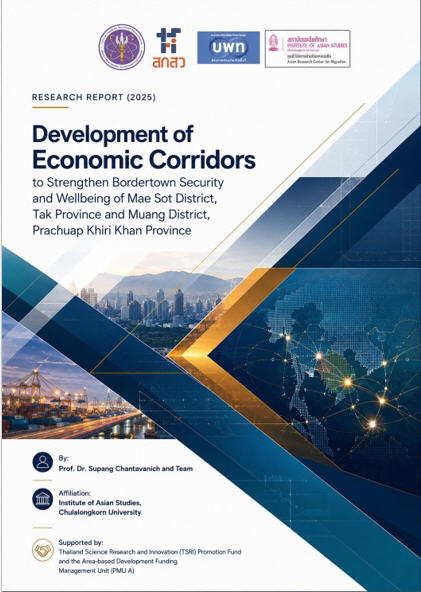
Code -E002 "Development of Special Economic Corridors to Enhance Security and Quality of Life in Border Cities: A Case Study of Mae Sot District, Tak Province, and Mueang District, Prachuap Khiri Khan Province"
Research Report (2025): "Development of Special Economic Corridors to Enhance Security and Quality of Life in Border Cities: A Case Study of Mae Sot District, Tak Province, and Mueang District, Prachuap Khiri Khan Province" Authors: Prof. Dr. Supang Chantavanich (Project Leader), Assoc. Prof. Dr. Naruemon Thabchumpon (Deputy Project Leader), Assoc. Prof. Dr. Chantana Wungaeo, Assoc. Prof. Dr. Ratiya Phulau, Asst. Prof. Dr. Sineenat Sermcheep, Dr. Premjai Wangsiripaisal, Ms. Somying Sunthrawong, Mrs. Supaporn Phokaew, Ms. Waranya Jitpong, Dr. Kamonwan Roengsamran, Dr. Phasakorn Yothinniranat, Dr. Supreecha Hiranburana, Mr. Itthipon Phromfai, Mr. Kritsanapon Witchupan, and Mr. Ukrit Saichumin. Project Overview: This research report examines the landscape of security, economy, quality of life, cross-border migration, public health, education, environment, and tourism in the border areas of Mae Sot District (Tak Province) and Mueang District (Prachuap Khiri Khan Province), employing a mixed-methods research approach. Abstract: This research project focuses on assessing the conditions and developmental gaps in the border areas of Mae Sot District, Tak Province, and Mueang District, Prachuap Khiri Khan Province, to design cooperation models and develop appropriate policy recommendations. The research findings indicate that both areas possess high potential to serve as model border cities; however, they continue to face challenges stemming from political volatility in Myanmar, unsystematic movement of people and goods, and issues related to public health and the environment. The research team proposes the establishment of a "Holistic Border Province Command Center" to integrate administrative management across agencies, alongside the development of collaborative mechanisms in five key dimensions: security, economy, well-being, education, and environment and tourism. These efforts, driven by multi-stakeholder participation, aim to achieve sustainable development and human security in the border regions.
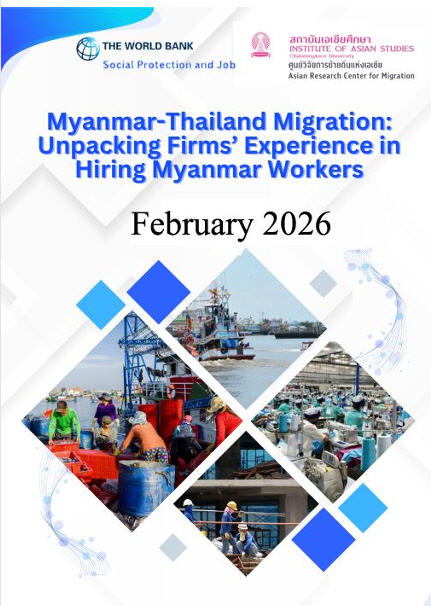
Code -E001 Myanmar-Thailand Migration: Unpacking Firms' Experience in Hiring Myanmar Workers
Article / Research Report: Myanmar-Thailand Migration: Unpacking Firms' Experience in Hiring Myanmar Workers
Author:Author: Institute of Asian Studies, Chulalongkorn University Presented Work:A complete research report from the 2024 project examining the experiences of Thai employers in hiring Myanmar workers under the Memorandum of Understanding (MOU) system and the Nationality Verification (NV) program, conducted by the Asian Research Center for Migration, Institute of Asian Studies, Chulalongkorn University . Abstract:This research report investigates the experiences and requirements of Thai employers hiring Myanmar workers through formal migration channels . It explores the impact of the post-pandemic environment and political instability on labor migration, identifies bottlenecks in recruitment processes, and examines the evolving demand for specific labor skills in various sectors . By analyzing firm-level data, the study offers evidence-based policy recommendations to streamline migration procedures, enhance labor rights protection, and support more transparent, lower-cost remittance channels to strengthen the labor market and regional economic cooperation .
Code E000 Cooperative Security in Southeast Asia: A Case Study of Natural Disaster Management
Article: Cooperative Security in Southeast Asia: A Case Study of Natural Disaster Management Author: Supreecha Hiranburana Abstract: Cooperative security is a strategic principle that prioritizes achieving shared objectives through consent rather than coercion or the threat of force . In the context of natural disasters, this strategy is utilized as a shared emergency response to restore stability and security to affected states and the broader Southeast Asian region . Because it relies on consent, this approach has proven effective for mobilizing sustained humanitarian assistance among neighboring states . By applying constructivist international relations theory, this study analyzes how shared norms, identity, and culture among ASEAN member states have facilitated the development of cooperative security in disaster response, specifically through the case studies of Indonesia, Thailand, and Myanmar.
|